

Origins
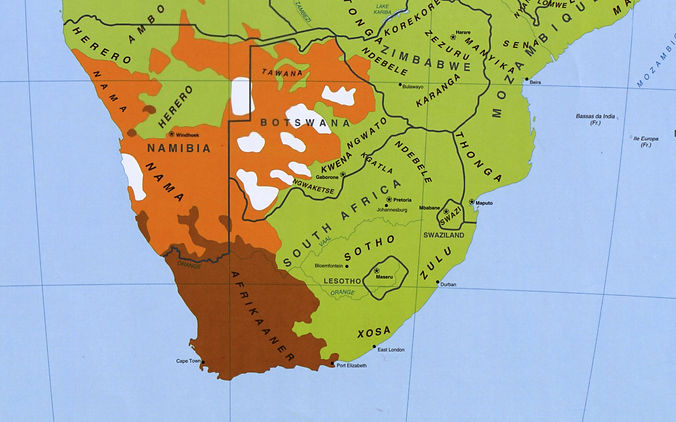
The Cape, Namibian and Kalahari territories were first inhabited by the nomadic Khoi-San people and later settled by proto-Afrikaners. The Bantu tribes and the Kaapenaars have vastly different origins and value systems that both settled in the sub-continent that became the Republic of South Africa.
Civilizations collide
During the 17th century European colonial powers divided Africa amounts themselves in pursuit of wealth and little regard for the peoples of Africa. The Dutch East India Trading Company (VOC) established a resupply outpost at what is today Cape Town, in 1652.
Bantu tribes inhabit much of sub-Sahara Africa and expanded from Northern and Central Africa to the North-Eastern parts of Southern Africa. Their expansion was constrained by pastures that could sustain cattle without supplemental feed. The dry areas of the Kalahari, Namib desert, Karoo and the Cape Peninsula were never settled by the Bantu peoples in great numbers.
The People that settled the Cape
Khoi-San
The nomadic Khoi, San and Strandloper people were the first inhabitants of the Cape, Namib and Kalahari deserts. They famously live in perfect harmony with Nature, more belonging to the land than the land belonging to them.
Proto-Afrikaners
Dutch VOC Frije Burgers were the first permanent settlers at the Cape of Good Hope who were joined by German and other European VOC employees and the French Huguenots fleeing religious persecution.
Cape Coloureds
Slaves from predominantly Asian extraction, such as modern-day Malaysia, Indonesia, Sri Lanka and Madagascar and Mozambique were imported as labour in the Cape, that fused to became known as the Cape Coloureds.
British
During the Napoleonic Wars, the British seized the Cape Colony from the Dutch and in 1820 settled the eastern frontier with Englishmen to form a buffer with the Xhosa people. Under British rule, the Cape colony expanded into the interior.
The Cape of Good Hope
In 1488, the Portuguese navigator and explorer Bartolomeu Dias became the first European to circumnavigate the southern tip of Africa. Disa originally named the archipelago Cabo das Tormentas, "Cape of Storms". The Portuguese later renamed it to Cabo da Boa Esperança or "Cape of Good Hope". This deliberate shift in meaning, from danger to promise, came at a pivotal moment in global navigation.
The people of the Cape of Good Hope find themselves once again at a pivotal, perilous moment where an alien oppressive regime has ruled over Kaapenaars for an entire generation. The international recognition of this abuse has created an inflection point to transcend our future, and once again provide a promise of hope and self-governance.
From Trading Outpost to the Republic of South Africa
1652 - 1806
The Dutch Cape Colony
With the arrival of Jan van Riebeeck, the Cape Colony was established as a colony of the Dutch East India Trading Company (VOC) As a resupply and layover port for vessels travelling between the Netherlands to Asia. Employees of the VOC became free citizens "Vrijburgers" of the Cape Colony after a mandatory five-year service.
1806 - 1910
The British Cape Colony
After briefly seizing the Cape in 1795 but returning it with the Treaty of Amiens in 1802 to the Dutch, during the Napoleonic Wars, in 1806 a second British invasion reoccupied the colony after the Battle of Blaauwberg and it remained a British colony until the establishment of the Union of South Africa in 1910. In 1836, approximately one-quarter of the Kaapenaars trekked into the interior to escape British subjugation. They formed several small republics, of which two received international recognition; Orange Free State and Transvaal. After the discovery of diamonds (1870) in the Orange Free State and gold (1886) in the Transvaal, Britain invaded and conquered these territories by 1902.
1910 - 1961
The Union of South Africa
Britain proclaimed the Union of South Africa in May 1910 as a dominion of Britain with limited self-governance after the Afrikaner leadership of the Orange Free State and Transvaal Republics surrendered and accepted British terms with the Treaty of Vereeniging in 1902. The National Party won elections for the first time on a platform of Afrikaner nationalism that led to policy of separate development and the Union's exit from the Commonwealth and the creation of the Republic of South Africa in 1961.
1961 - 1994
The Republic of South Africa The NP Regime
The period was characterised by white Nationalist’s preoccupation with self-determination that led to establishment of Apartheid and ultimately leading to the black armed struggle. By the mid-80s, the NP regime started to dismantle apartheid and reform. With the dissolution of the Soviet Union, international pressure mounted that there was no justification for apartheid based on a fear of communism.
The NP regime held a referendum in 1992 that asked the following simple question: "Do you support continuation of the reform process which the State President began on 2 February 1990 and which is aimed at a new Constitution through negotiation? Yes / No." President F.W. de Klerk took this as a mandate to unilaterally abdicate all power and implement a new political dispensation that relied solely on the protection of minority rights by the constitution.
1994 - Present day
The ANC Regime
The period leading up to and during the negotiations between 1989 and 1994 were marked by the ANC’s Peoples War wherein approximately 15,000 black people were killed. The People’s war was based on the Vietnamese concept to intimidate the populous into cooperation and support.
The African National Congress (ANC) formed an alliance with the South African Communist Party (SACP) and COSATU, the trade union movement that won the election by 62% and and I've been governing South Africa with impunity ever since.